
Juvenile Release Records Stay Confidential
Champaign County Juvenile Detention Center serves minors in delinquency proceedings. It is operated through Champaign County Probation and Court Services, not through the public adult jail lookup. Illinois juvenile confidentiality changes the entire access path. There is no public released-person roster to browse, no adult jail result to interpret, and no basis to publish a minor's custody or release status from an open search.
An authorized inquiry begins with the facility, Probation and Court Services, counsel, or the juvenile court. Staff may need to verify the caller's identity and relationship to the case before discussing any detail. A public records request does not erase the juvenile restrictions that apply to protected case and detention information. If disclosure is denied or limited, use the court or counsel route that fits the person's legal authority rather than moving to an adult or commercial search.
Juvenile Detention Record Contacts
Facility questions should go to the Juvenile Detention Center at the Art Bartell Road address. Broader probation and court-services questions can be directed to the county office at Main Street. The office lists regular weekday hours and advises callers to contact staff rather than appear without an appointment or court order. Those contacts are administrative paths, not permission for public access.
Champaign County Juvenile Detention Center
400 S. Art Bartell Rd.
Urbana, IL 61802
Phone: 217-384-3780
Probation and Court Services
101 E. Main St.
Urbana, IL 61801
Phone: 217-384-3753
Email: courtservices@co.champaign.il.us
Monday through Friday, 8:00 a.m. to 4:30 p.m.
Do not send juvenile questions to adult Corrections merely because both facilities are in Champaign County. The Sheriff's adult records and Daily Reports cover a different detention system. A juvenile court file may also be unavailable to the general public even when an adult criminal file would be open.
Champaign Juvenile Detention Operations
The center is a secure juvenile detention facility for minors alleged or adjudicated delinquent. “Alleged” means the accusation has not yet been finally decided. “Adjudicated” is the juvenile-court term for a finding made through that system. Neither term turns the youth into an adult jail inmate. The facility's role, records rules, court process, and release planning remain distinct from the Sheriff's adult Corrections Division.
The official county facility page is shown below. The Champaign County juvenile detention source provides the proper agency context and contact route.
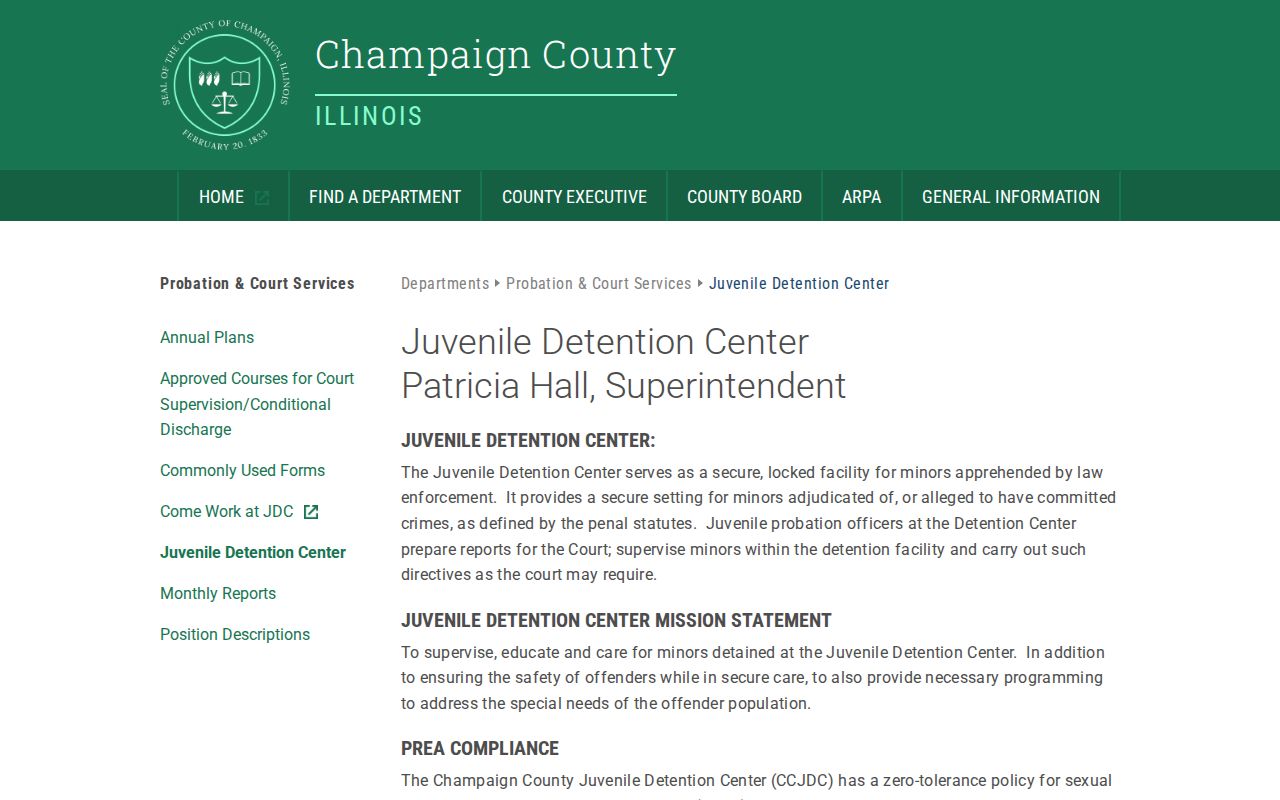
The county source confirms why Probation and Court Services, not an adult released-inmate list, is responsible for authorized juvenile inquiries.
- Delinquency proceeding
- A juvenile court case involving conduct alleged against a minor.
- Detention
- Secure custody pending or during juvenile court action.
- Placement
- A court or agency-arranged destination that may follow detention and is not always a return home.
- Confidential record
- Information whose access is limited by law, court rule, or order.
Juvenile Release Destination Checks
A juvenile detention departure can lead to a parent or guardian, a court-approved placement, another secure setting, treatment, or another arrangement set through the case. The research does not support publishing a standard destination or public release schedule. Staff and the juvenile court must give authorized people the case-specific instructions. A departure from the building should not be translated into an unsupported claim about where the minor went.
Adult Daily Report categories do not apply to this facility. The Sheriff's labels for Notice to Appear, pretrial release, sentence served, or transfer describe adult Corrections reporting. Juvenile detention uses a separate legal and administrative process. The adult IDOC offender search is also not a route to a juvenile detention release unless a later, distinct adult state-custody record exists, which must be treated as a different episode.
| Question | Correct route |
|---|---|
| Is a minor currently held or released? | Authorized contact with Juvenile Detention, Probation and Court Services, counsel, or juvenile court |
| What pickup or placement direction applies? | Case-specific instruction from the responsible facility or court authority |
| Can the adult jail portal confirm it? | No; the adult portal is the wrong system |
| Can a public request override confidentiality? | No; juvenile restrictions and exemptions still control access |
Juvenile Court Forms and Records
Champaign County publishes commonly used Probation and Court Services forms. Those forms can help an authorized participant identify the correct county process. They do not make the underlying juvenile detention record public. A form's availability and a case record's availability are separate questions.
The manifest includes the county forms source below.
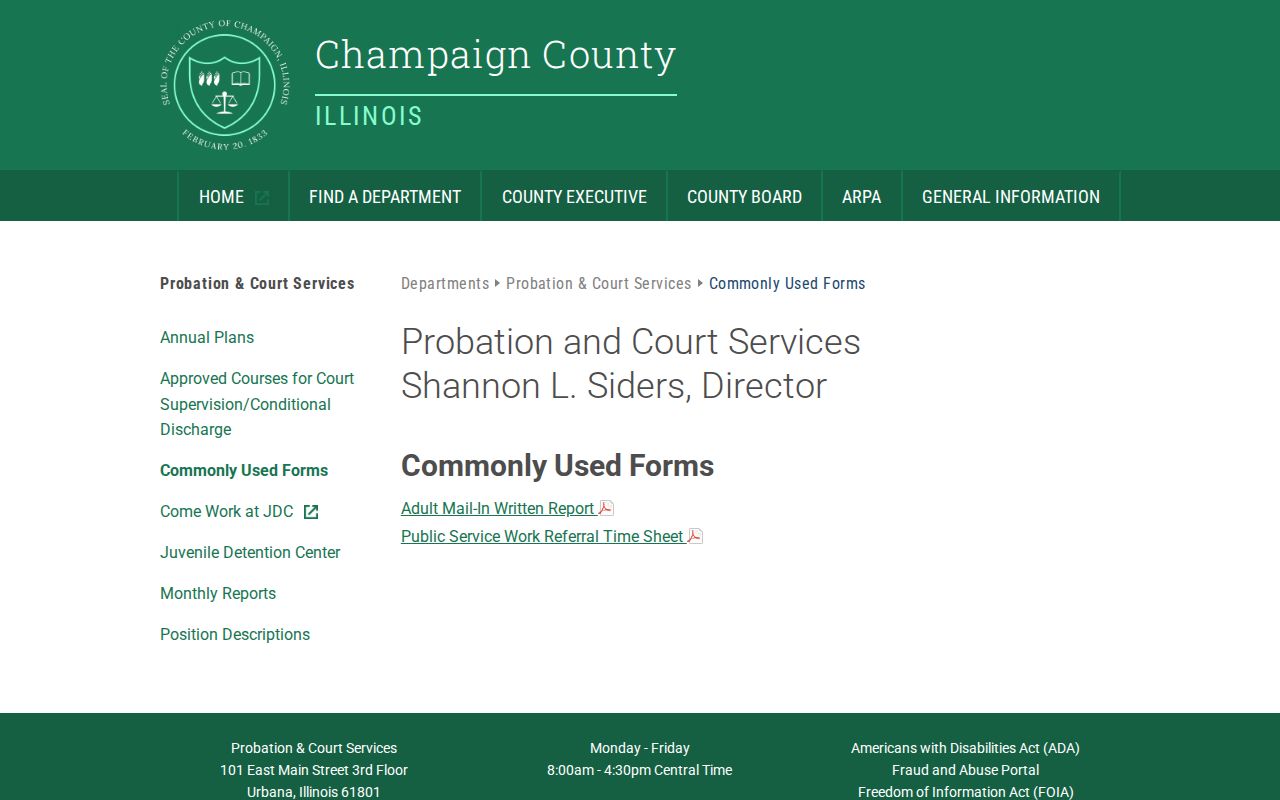
The forms page supports routing to Probation and Court Services while preserving the confidential nature of the youth's detention and court information.
If a court document is needed, ask counsel or the juvenile court what proof of authority and what filing method apply. The Circuit Clerk's public file guide expressly identifies juvenile delinquency and juvenile abuse or neglect matters among restricted case categories. Public search absence can therefore reflect confidentiality. It must not be treated as evidence that no detention, hearing, release, or placement occurred.
Separate Juvenile and Adult Records
Champaign County operates different paths for adult jail records and juvenile detention records. Adult detention is run by the Sheriff at Lierman Avenue. Its known-name portal, Daily Reports, Corrections line, and Sheriff FOIA process can provide adult release clues or records. Juvenile detention is run through Probation and Court Services, and confidentiality limits disclosure. Sending a juvenile inquiry through adult tools risks both a false result and improper handling of a minor's identity.
The main Champaign County adult release-record search should be used only when the person and custody episode belong to the adult jail, IDOC, or another adult system. It should not be used to infer juvenile status. If a person later has an adult custody record, keep that later record separate from any protected juvenile matter.
Note: Similar names across adult and juvenile systems are not proof that records concern the same person.
Champaign Facility History Distinction
Champaign County's adult jail history can cause location confusion, but it does not change the juvenile route. The former Downtown Correctional Center closed, and adult operations were consolidated at the Satellite Jail on Lierman Avenue. The Juvenile Detention Center remains a separate facility on Art Bartell Road under Probation and Court Services. It was not part of the public adult roster before or after that consolidation.
Older county directory labels may mention downtown adult detention. Those labels concern the former adult site, not the juvenile center. Historical adult release requests go to Sheriff records. Current adult custody checks go to Lierman. Authorized juvenile questions stay with Juvenile Detention, Probation and Court Services, counsel, and the juvenile court. Keeping these three routes distinct prevents a closed adult facility, an active adult jail, and a confidential youth facility from being treated as one public system.
Respect Juvenile Record Limits
Confidentiality is not a data gap to work around. It is a governing limit on who may receive juvenile information. Do not post a youth's name, custody claim, release date, placement, or case details based on rumor or an unrelated adult search. Use official contacts, identify the authorized role, and follow the court's direction. When the office confirms only a narrow fact, do not expand it into a broader account.
A careful inquiry also avoids asking for an entire history when one authorized fact will meet the need. Request the minimum necessary release, pickup, placement, or court detail. If records are restricted, counsel can explain whether a motion, order, consent, or other legal route is required. The facility cannot be expected to discuss protected information simply because a caller knows a name or address.
Public Record Search
Sponsored Results