
Champaign Parole and Probation Compared
Probation is a sentence or disposition ordered by the Champaign County circuit court. Champaign County Probation and Court Services handles local supervision. Parole or mandatory supervised release, often shortened to MSR, follows an Illinois prison term. IDOC's Parole Division provides field supervision, while the Illinois Prisoner Review Board sets conditions and decides matters within its hearing authority.
| Feature | Parole or MSR | Probation |
|---|---|---|
| Source | An IDOC sentence and state release framework | A circuit-court order |
| Supervising body | IDOC Parole Division | Champaign County Probation and Court Services |
| Public proof | IDOC status, sentence fields, and relevant PRB records | Court docket and probation order |
| Violation route | PRB revocation process and possible IDOC return | Local court process under the probation order |
| End point | Final discharge from the state correctional term | Termination or completion under the court record |
The labels should not be exchanged. A probation order does not appear in a state parole calendar simply because the person once spent time in the county jail. Likewise, a parole status means the person has left the prison institution but remains within the state correctional sentence.
- Parole
- Community supervision connected with release under the state prison system.
- Mandatory supervised release
- A required supervision term following many modern Illinois prison sentences.
- Probation
- Court-ordered community supervision handled locally.
- Discharge
- The formal end of the sentence or supervision obligation.
- Absconder
- A person alleged to have left required supervision without authorization; it does not mean discharge.
Verify Champaign Post-Release Supervision
Start with the sentencing system. A county jail release can lead to probation, no supervision, transfer, or another outcome. A state prison release commonly leads to parole or MSR. The records must show which path applies.
- Find the Champaign County court case and read the sentencing, probation, or termination order. A docket label alone may omit key terms.
- Search IDOC by last name, IDOC number, or birth date if the person was committed to state prison. Confirm identity and read the current status.
- Interpret a parole or MSR result as release from prison with supervision still active. Do not confuse a projected parole date with a completed release.
- For probation, contact Champaign County Probation and Court Services. Public verification of another person's details may be limited, but the court order can establish that probation was imposed.
- Check the Illinois Prisoner Review Board hearing or revocation material only when the state case falls within that process.
- Date every result. A later violation, revocation, discharge, or amended court order can change the status.
The broader Champaign County release-record search helps establish the jail or prison exit before supervision is interpreted.
Champaign County Supervision Offices
For local probation, use Champaign County Probation and Court Services. Its office is at 101 E. Main Street, Urbana, IL 61801. The phone is 217-384-3753 and the general email is courtservices@co.champaign.il.us. County material lists Monday through Friday hours of 8:00 a.m. to 4:30 p.m. Call before appearing unless a court order directs otherwise.
Probation and Court Services
Address: 101 E. Main St., Urbana, IL 61801
Phone: 217-384-3753
Email: courtservices@co.champaign.il.us
Hours: Monday through Friday, 8:00 a.m. to 4:30 p.m.
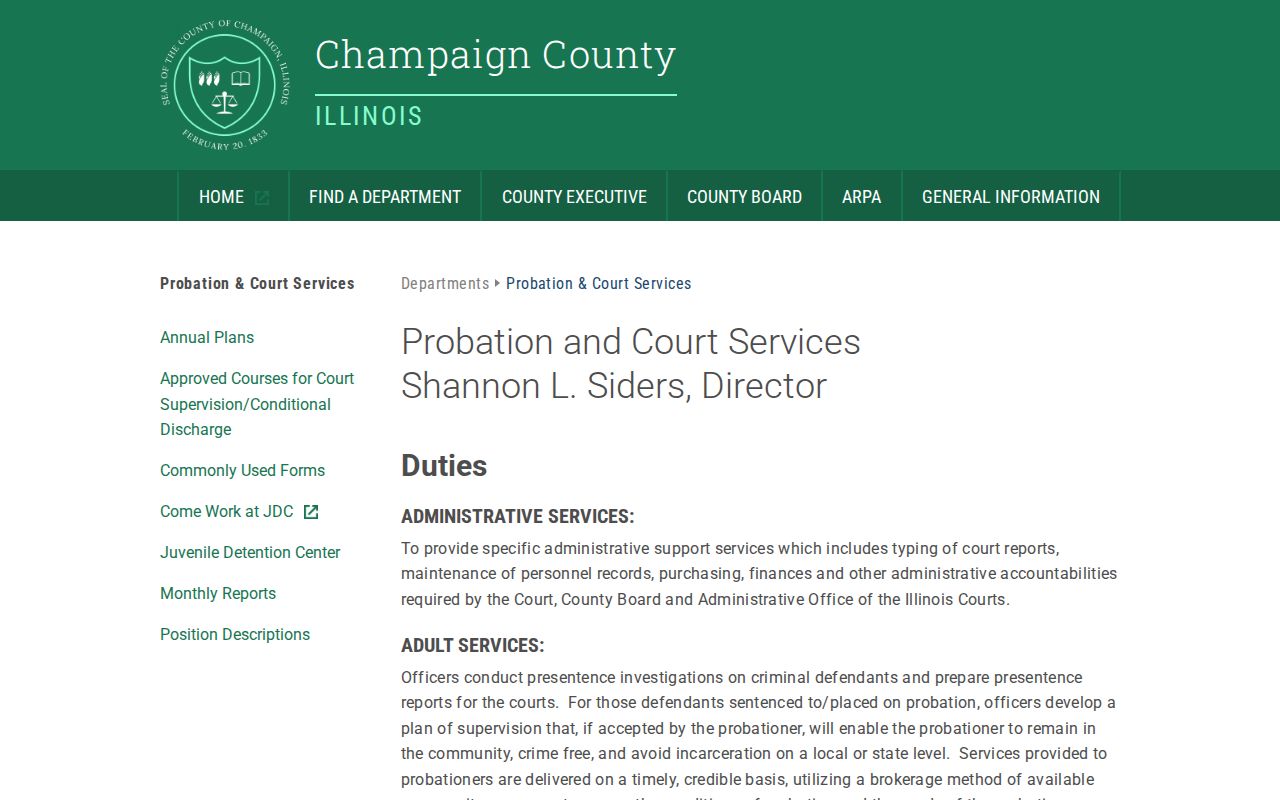
The county page confirms the local probation route. Parole and MSR remain state matters. IDOC's public information line is 217-558-2200 when the individual state record does not identify a current contact. The Illinois Prisoner Review Board is at 319 E. Madison St., Suite A, Springfield, IL 62701, with phone 217-782-7273.
Champaign Parole Hearing Records
The Illinois Prisoner Review Board publishes hearing information, a Monthly Board Calendar, facility dockets, a yearly en-banc schedule, current results, past parole grants, and revocation records. En-banc meetings occur monthly. Current materials describe video hearings, and the active document date should always be checked because schedules change.
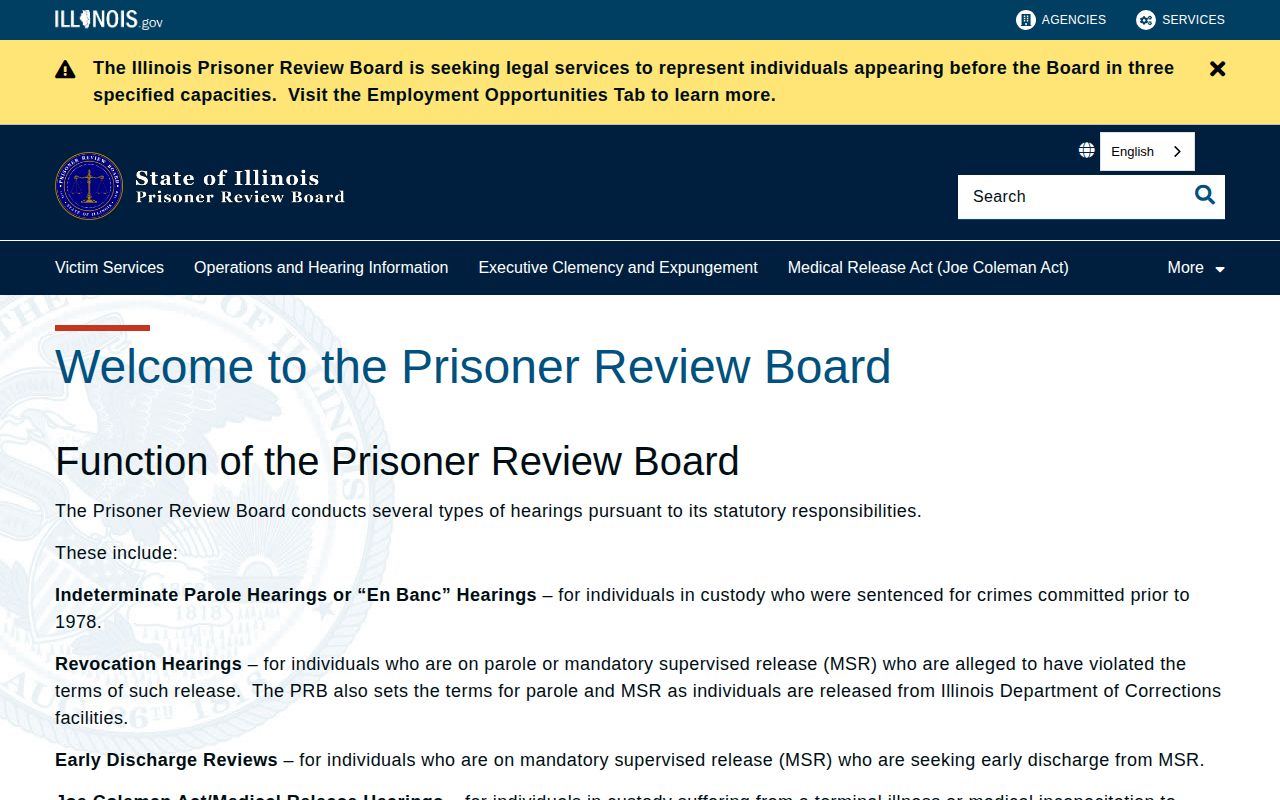
Not every Illinois prisoner awaits a discretionary parole grant. Modern determinate sentences generally proceed through statutory sentence credit and MSR. Legacy pre-1978 indeterminate C-number cases can receive parole hearings under 730 ILCS 5/3-3-3. For those cases, a grant may still depend on an approved release plan, so the decision should be checked against the later IDOC status and actual release date.
When the Board denies parole in an eligible legacy case, it can set a later hearing. A published grant or denial records a decision, not necessarily the person's present location. The IDOC individual record supplies the current state-custody or supervision layer.
Champaign Supervision Violations and Absconders
An alleged violation does not erase the earlier release. It can lead to changed conditions, a hearing, continued community release, or a return to custody. IDOC's Wanted Fugitives page is the identified state route for an alleged unauthorized absence from state supervision. An absconder listing means the state alleges the person is not complying with required supervision; it is not a discharge record.
PRB revocation materials distinguish stages and outcomes. A preliminary hearing addresses probable cause. A final hearing can find a violation and continue release with conditions, find no violation and resume release after plan approval, or revoke release and return the person to IDOC for recalculation. Appeals may reset, affirm, or reverse an earlier result.
Probation violations use the Champaign County court process, not the PRB calendar. Read the local docket and resulting order. A custody-change alert from Illinois VINE may help track a participating agency event, but it does not establish the legal outcome of a violation hearing.
Champaign Release Conditions and Status
Conditions are the rules attached to community supervision. The Illinois Prisoner Review Board sets conditions within its parole and MSR role. The circuit court sets probation terms. The exact order controls, so broad descriptions should never replace the person's filed record.
Public records may confirm the supervision type, start point, hearing result, or termination. They may not disclose every reporting detail or private service need. Contact the supervising office for an official interpretation, especially when a new order, warrant, or revocation result appears. The office may limit what it can disclose about another person's current supervision.
Illinois VINE provides confidential custody and court-event notifications through participating systems. It is not a supervision compliance tracker. Register while a matching active record is available, then verify any alert with IDOC, the local court, or the supervising office.
Champaign Reentry During Supervision
County-funded Rosecrance Central Illinois WIN Recovery Criminal Justice programming spans the jail, probation, and community. Program summaries describe assessment, case management, groups, and transition assistance. Local presentation materials also identify the Reentry Council. These services can support a person moving from custody into community life.
Reentry help does not replace supervision. A person on county probation must follow the circuit-court order and Probation and Court Services instructions. A person on IDOC parole or MSR must follow state conditions and the Parole Division's direction. The local program is a navigation and support layer beside those legal duties.
Champaign Identification After Release
Rosecrance materials specifically identify help obtaining state identification, birth certificates, and Social Security cards. Replacing those documents can be a practical part of reentry while supervision begins. The service should be approached through the local program contacts rather than assumed to be part of the probation or parole office's public-record function.
A mistake in a custody or supervision record follows a separate route. A wrong Sheriff release record belongs with the Sheriff's FOIA or records officer and should include booking details plus the correct court document. A wrong court order or docket entry belongs with the Circuit Clerk process. IDOC record errors should be supported with the committing-court material and directed to the state agency.
When Champaign Supervision Ends
Probation ends through the court process reflected in a termination, completion, revocation, or other final order. Confirm the result in the Champaign County case. Do not infer completion merely because the original term appears to have elapsed; tolling, amendments, or a pending violation can affect the record.
State parole or MSR ends at final discharge from the Illinois correctional term. IDOC distinguishes the projected parole date, which anticipates prison release to supervision, from the projected discharge date, which ordinarily anticipates the end of the broader obligation. A fully discharged person may no longer appear in the ordinary IDOC public search. IDOC's archived Record Search or FOIA route can supply older discharge information.
Illinois public-record exemptions can limit access to sealed, expunged, juvenile, medical, and personal-identity material. Public absence should not be converted into a claim that supervision never existed. Use the final court or agency record as the endpoint.