
Former Downtown Center Closed
Former Downtown Correctional Center was a Champaign County adult jail. It is not an active detention facility and should not be used as a place to locate, visit, or collect someone now. County planning called for adult jail operations to be consolidated at the Satellite Jail. A local history account states that all people were moved and the downtown jail closed for good in 2022. Current adult custody questions must go to the Sheriff's Corrections Division at the Lierman facility.
The old name can still appear in historical booking material and county contact directories. Some county pages retain a DT Adult Det. label and an older downtown detention number. That legacy wording does not show that the building reopened. It describes an old site or a contact category. When a historical record says Downtown Correctional Center, keep that facility wording in the request and ask the Sheriff to identify the custody dates, release event, and destination.
Downtown Jail Closure Record
The Champaign County jail master-planning record documents the move toward one adult detention campus. Its role is more than historical background. It helps resolve an apparent conflict in county sources: a directory can preserve a downtown label while current operational material places the adult jail population at the Satellite Jail. The planning record supports routing all present adult custody checks to Lierman.
The manifest image below captures that official consolidation source.
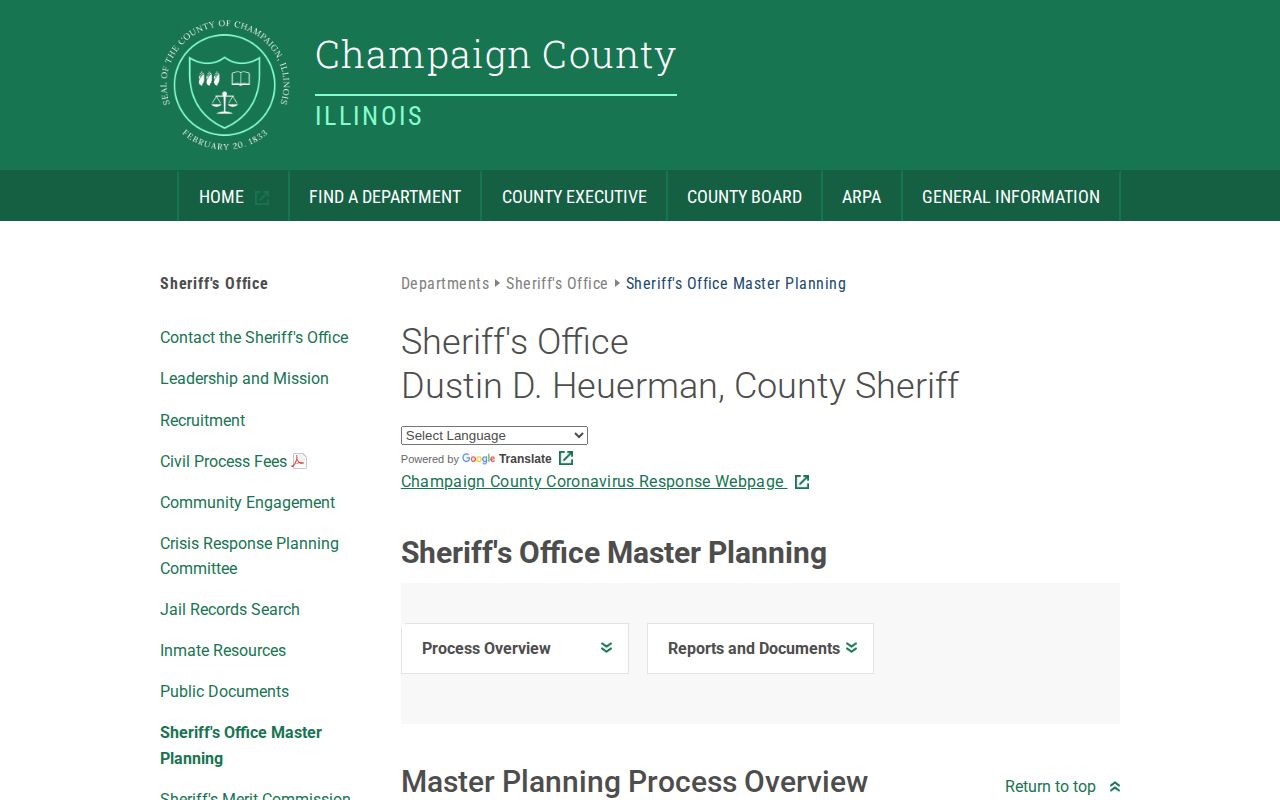
The county planning view explains why Former Downtown Correctional Center is a records label now, not a second active Champaign County jail.
A separate Prairie Prisons historical account records the downtown facility's final closure in 2022. The second manifest image preserves that local historical context.

Together, the sources show that an older downtown booking must be researched through retained county records, while a current adult jail check belongs at Lierman.
Find Downtown Release Records
A historical release request should identify the person and the old custody episode as precisely as possible. Include full legal name, date of birth, approximate arrest and release dates, booking number, and court case number when known. State that the record may identify Former Downtown Correctional Center or downtown adult detention. Ask for the booking/release sheet, actual release date and time, release type, authorizing order reference, and destination or receiving agency.
Use a narrow sequence so each source answers the right question.
- Search the Circuit Clerk record for the case number, disposition, release order, sentence, custody credit, probation order, or transfer entry.
- Send the saved Sheriff FOIA form to the Sheriff's records officer and name the old downtown facility label.
- Compare the court authority with the Sheriff's completed release entry. The order and physical exit may occur at different times.
- If the record shows transfer to IDOC or another county, continue in that receiving system.
- For current custody, stop using the downtown name and contact the active Lierman jail.
The Sheriff FOIA form can be emailed after it is saved. Ordinary county FOIA requests generally receive compliance or denial within five business days, subject to a possible written extension of up to five more business days. Record existence and exemptions still control disclosure. No Sheriff retention schedule for old release sheets was found, so the request should provide enough detail for an archive search.
Read Downtown Release Evidence
Old jail records can establish several different facts. A booking record proves intake into a custody episode. It does not prove when the person left. A court order shows legal authority for release, dismissal, sentence credit, probation, or transfer. It may not show the minute the jail completed processing. A completed booking/release sheet is the most direct county proof of the physical exit and its stated type.
| Historical source | What it can establish | Limit |
|---|---|---|
| Downtown booking entry | Identity, booking, and the former facility label | Does not prove release |
| Circuit court file | Disposition and legal authority for the custody change | May not state actual exit time |
| Sheriff booking/release sheet | Actual release date, time, type, and destination if recorded | Disclosure depends on record existence and exemptions |
| IDOC record | Later state custody, parole, or state release | Does not replace the earlier county record |
Historical labels require care. Release to another agency ends the Champaign County episode but may begin another custody episode. A state commitment belongs in the IDOC search. A transfer to another county belongs with that county. A treatment placement is not an ordinary community release. Preserve the original language and avoid reducing every exit to one generic result.
- Historical facility
- A closed detention location that may remain named in archived records.
- Release
- The end of the identified jail custody episode.
- Transfer
- A move to another custodian or placement rather than proof of return to the community.
- Disposition
- The court's formal result in a case, which may explain the legal reason for release.
Downtown Records Stay With Sheriff
There is no separate downtown records desk to visit. Send historical adult detention requests to the Champaign County Sheriff's Office. The records address is 204 E. Main Street in Urbana, not the former detention building. The designated FOIA officer listed in the research is Lt. Brad Wakefield. Email is the clearest route for an electronic request, and fax or mail remain available.
Champaign County Sheriff Records
204 E. Main St.
Urbana, IL 61801
Phone: 217-384-1215
Fax: 217-384-1219
Email: sherifffoia@champaigncountyil.gov
Monday through Friday, 8:00 a.m. to 4:30 p.m., except holidays
Ask for electronic copies when practical. Illinois FOIA allows copying costs under the county schedule, while electronic delivery may limit those charges. If part of a record is withheld, ask the office to identify the legal basis and release any segregable, nonexempt portion. Court papers must be obtained from the Circuit Clerk because the Sheriff holds arrest and detention records, not the court file.
Route Current Champaign Jail Checks
Present adult detention operates through the Champaign County Jail at 502 S. Lierman Avenue. The Sheriff's online portal is a known-name search requiring both first and last name. It shows current charges and bond amounts, but the county does not promise an archive of released people in that portal. A current absence can mean release, transfer, spelling trouble, or an update delay.
Corrections Daily Reports provide near-term clues. They summarize prior-day bookings, arrests, release totals, and release types, with some people named in a forward-looking Releasing Today block. They do not name everyone released. For a completed present-day exit, call Corrections and request the release sheet when formal proof is needed. Details for the active location appear on the Champaign County Jail release page.
Operating Adult Jail
Champaign County Jail
502 S. Lierman Ave.
Urbana, IL 61802
Corrections: 217-384-1243
Note: An old downtown label helps locate an archived record, but it must never redirect a current custody inquiry away from Lierman.
Pair Downtown Court Records
The Champaign County Circuit Clerk can supply the legal layer behind an old detention episode. Relevant documents may include a dismissal, release order, sentence, amended sentence, custody-credit entry, probation order, or completion order. The Clerk's public file guide also explains that sealed, expunged, juvenile, and other restricted cases may not be open for public inspection. A missing public case is therefore not proof that no downtown custody occurred.
For a precise history, compare dates across the docket and Sheriff record. The court may have entered an order before jail processing ended. A transfer can also follow a county order without producing a community release. If the case led to state imprisonment, IDOC becomes the source for later parole and discharge facts, while the Sheriff's archive remains the source for the earlier downtown exit.
What Downtown Closure Changes
Closure changes where questions go, not the meaning of the old records. The former building has no current detainees, release schedule, public roster, or pickup point. Sheriff records remain the route for the county custody episode. The Circuit Clerk remains the route for the court authority. A later agency remains responsible for any custody that followed the downtown release or transfer.
This distinction prevents two common errors. First, an older directory entry should not be treated as proof of two active adult jails. Second, a county transfer should not be described as release to the community. The Former Downtown Correctional Center page exists because the name is still useful for an archive request, even though it is no longer useful as a live location.
Public Record Search
Sponsored Results